

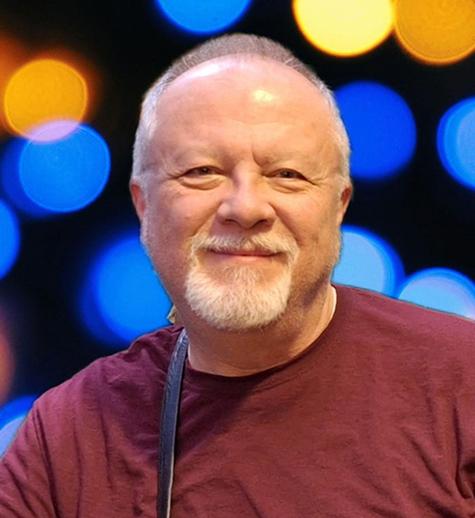
Jon Jaramillo
Biography
Jon Dell Jaramillo, Ph.D., is an Assistant Teaching Professor of Spanish at the University of Oregon, where he teaches in the Department of Romance Languages and the Schnitzer School of Global Studies and Languages. A scholar, translator, editor, writer, and educator with deep ties to both the United States and Ecuador, his work brings together Latin American cultural studies, translation studies, queer studies, memory, cinema, gender and sexuality studies, postcolonial thought, and the ethical application of artificial intelligence in education and creative practice.
Jaramillo came to higher education as a nontraditional student after a long and varied personal and professional journey. He earned his bachelor's degree at age fifty and completed his Ph.D. in Romance Languages and Literatures at the University of Oregon at age sixty-one. His academic path has shaped his commitment to resilience, lifelong learning, and expanding access to intellectual and creative work for students whose experiences do not always fit traditional educational trajectories.
His doctoral research examined illness, stigma, identity, embodiment, and cultural memory in Latin American life writing. His dissertation, Viral Bodies: AIDS and Other Contagions in Latin American Life Narrative, explores how marginalized subjects narrate experiences of illness, exclusion, and survival while negotiating broader structures of political, social, and cultural power. More broadly, his research interests include queer and trans studies, women's and gender studies, translation, memory studies, Latin American cinema and literature, postcolonial studies, philosophy, poetry, and the relationship between narrative and social justice.
Translation is central to Jaramillo's scholarly and creative practice. He approaches translation not simply as linguistic transfer but as a form of cultural interpretation, ethical responsibility, and intellectual collaboration. His Queering Translation Manifesto advocates for approaches to translation that remain attentive to identity, power, cultural difference, and the political dimensions of language. His translation work includes Michel Estrada's The Neurosurgeon and the English translation of Mexican writer Margarita Moreno Zárate's memoir De primera fuente, published as From the Source. The project ultimately resulted in Spanish, English, and bilingual editions of the work.
Jaramillo is also active in independent publishing. Before founding his current press, he published De primera fuente and its translated and bilingual editions under an earlier editorial imprint. He now serves as President and Managing Editor of Gran Camino Press, an Ecuadorian publishing initiative dedicated to helping writers develop, edit, translate, and publish work that might otherwise remain outside conventional publishing channels. The press emphasizes careful editorial collaboration, accessible publishing models, and the circulation of voices and stories rooted in Latin America and other underrepresented communities.
Among his most recent editorial and translation projects is Nelson “Omar” Tello Benalcázar's El hombre que sembró su propia selva, a memoir and environmental testimony centered on Tello's decades-long restoration of a tropical forest in the Ecuadorian Amazon. Jaramillo oversaw the book's editorial development, publication, and international presentation and completed its English-language translation, which has also been published. The Spanish and English editions were formally presented on September 4, 2026, during a two-hour public event at the Casa de la Cultura Ecuatoriana, Núcleo de Pastaza, in Ecuador. The project has also contributed to his growing research interest in Amazonian memory, environmental knowledge, testimony, ecological restoration, and alternative visions of the region's future.
At the University of Oregon, Jaramillo's teaching emphasizes advanced language development, critical inquiry, cultural interpretation, authorship, and responsible engagement with emerging technologies. He has designed courses that integrate literature, film, media, translation, multimodal analysis, and project-based learning. His pedagogy frequently asks students to examine questions of identity, power, representation, memory, resilience, and solidarity while developing sophisticated communication skills in Spanish.
A major area of his recent work focuses on artificial intelligence literacy in higher education. Jaramillo develops pedagogical models that move beyond simple discussions of whether students should or should not use generative AI. Instead, his teaching examines how AI systems work, how they shape authorship and knowledge production, and how students can use them critically, transparently, and ethically. His work addresses issues including bias, privacy, surveillance, intellectual property, academic integrity, global regulation, and the changing relationship between human creativity and automated systems.
He developed Artificial Intelligence in Global Contexts, an interdisciplinary course designed for students across fields and levels of technical experience. The course introduces students to the foundations and social implications of artificial intelligence while foregrounding ethical reasoning, global perspectives, authorship, and responsible use. Through case studies, applied workshops, collaborative projects, and international exchange, students examine AI not merely as a technical innovation but as a cultural, political, economic, and ethical force.
Jaramillo is also involved in the development of Collaborative Online International Learning (COIL) initiatives connecting University of Oregon students with students and faculty at partner institutions abroad. These projects extend his commitment to intercultural learning and global education while exploring how digital technologies can create meaningful forms of exchange across linguistic, geographic, and institutional boundaries.
His current research and professional projects increasingly connect scholarship, teaching, publishing, environmental humanities, and artificial intelligence. These include work on AI literacy in language education, interdisciplinary curriculum development, international educational collaboration, Amazonian testimony and ecological futures, translation and publishing, and emerging questions surrounding authorship and creative production in the age of generative AI.
Across these areas, Jaramillo's work is guided by a consistent commitment to the humanities as a space for inquiry, creativity, and human connection. Whether working with students, authors, translators, or community partners, he is particularly interested in how education, storytelling, translation, publishing, and emerging technologies can expand access to knowledge, preserve experiences that might otherwise disappear, and create new possibilities for people to tell their own stories.