
Everyone needs a team of confidants and advisors — whether you’re the president of the U.S. or a political scientist writing about one of the most powerful elected persons in the world.
For the past several years, College of Arts and Sciences political scientist Chandler James has studied the norms and values that define the presidency. From wearing a U.S. flag pin and releasing tax records to press meetings and tan suit controversies, the president has been beholden to a set of informal and unofficial rules that have been created by institutions like the media and past presidents.
James is wrapping up his first book, which focuses on these norms and how the public perceives them. As James finishes his book, he enlisted help from academic experts on the presidency from across the country.
“Imagine me as a sculptor. I sculpted this statue but it’s only 75% rendered,” James said.
What are presidential norms and values?
James has long been fascinated by U.S. presidents and the office, back to when he was an undergraduate student at the University of Chicago.
At first, James was fascinated by the cult of personality in presidents, a phenomenon in which public admiration of a leader transcends into unwavering loyalty. As James studied this phenomenon, he found that what would be more measurable as a scholar are the norms and values that have defined the presidency.
Established by institutions surrounding the presidency, such as the media, fellow politicians, and past presidents, norms and values exist to keep presidents from becoming tyrannical and to ensure they respect certain values of the presidency, James said.
“Presidents adhere to norms because they're widely supported, and you don’t want to get punished,” James said. “People like it when a president wears a suit, so they wear one. They also might believe in norms, like presidents should not use public office for private gain. Or they might have a status quo bias, thinking that it’s the way it’s always been done, so they’ll keep doing it.”
James added that a president violating a norm could be done to signal to voters that they aren’t part of the political establishment, for example.
“Another thing is that norm violations are attention-grabbing, so if you want to stand out, do something distinctive,” he said.
But norms also exclude those who might not be seen as presidential material. Norms of a president have also established what religion a president should follow, as well as their race, sexuality, and gender.
“My task has been understanding why we care about these norms and what they mean,” James said. “How do they structure power in the modern presidency? That's the goal of my book.”
Norms and values in the presidency
President Donald Trump’s three campaigns and tenure in the White House have been marked by him not adhering to some norms and traditions. Yet he has had success in elections and loyalty from his political party.
“It seems President Donald Trump violated all these norms, but he wasn't punished for it. How did he get away with being such a norm violator? That's the question. That’s what brought me to this research,” James said. “Why do norms bind in some cases but not in others?”
Throughout his book, James aims to take a scientific approach to understanding these at times invisible rules on the presidency. James conducted public opinion surveys, analyzed articles by journalists, and examined scholarship by political scientists to understand norms. Then he surveyed thousands of people over multiple years about their views on the norms to see how the public perceives presidential norms.
“How deep is their commitment to norms? Where are they willing to give up? And who are the people that support norms?” James said.
In his research, he’s found that political parties differ in how they perceive norms in the presidency. Liberals and Democratic Party-aligned voters value releasing tax returns, facilitating a peaceful transfer of power, and not using the office for private gain. Conservatives and Republican Party-aligned voters put stock in presentational norms, which include saluting military officials outside of Air Force One, wearing a U.S. flag on a suit lapel, and swearing in on a Bible.
President Barack Obama made headlines when he wore a tan suit in 2014. But he wasn’t the first president to wear one. In James’ survey, he asked participants to rank how presidential it is to wear a navy-blue suit versus a tan suit.
“Obama is punished much more harshly than Reagan is for wearing a tan suit. Republicans like Reagan in a tan suit or a navy suit,” he said. “Democrats really love Obama in the navy suit, but they punish him for wearing the tan suit.”
With a little help from his friends
James’ book dives deeply into understanding the fractures within party affiliations. Thanks to financial support from the Department of Political Science and the University of Oregon Division of Equity and Inclusion, he invited experts from around the country to sharpen his book.
Th scholars supported James as he clarified why some norms are relevant in some cases but not others, fine-tuned the book’s structure and applied how evidence supports his book’s larger argument.
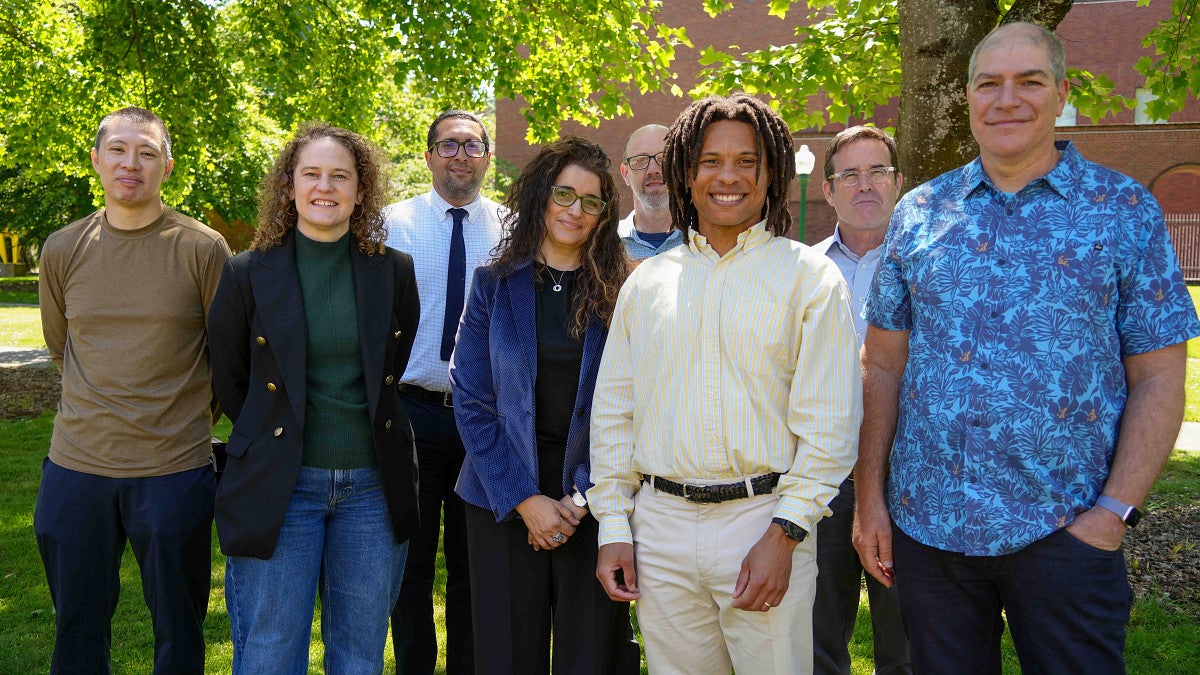
Through this support, James brought in Professor Christopher Stout (University of California, San Diego), Professor David E. Lewis (Vanderbilt University), and Associate Professor Hannah Walker (University of Texas, Austin). CAS political science professors Dan Tichenor and Alison Gash attended as well.
“Having nationally recognized scholars taking your ideas, arguments and research seriously, it’s a really humbling experience — it’s awesome,” James said.
— By Henry Houston, College of Arts and Sciences