
By Violet Ashley, student writer, College of Arts and Sciences
Terence McCulley ’79 (French, history) is a decorated former U.S. ambassador whose dynamic 41-year career in Africa began with an interest in the French language.
McCulley was born in Medford, Oregon, and grew up in Eugene. He said he “felt a call” to learn a foreign language all the way back in grade school. He started with Spanish, then transitioned to French in high school, developing a love of the language and France’s literature and history.
A foreign language foundation
McCulley double majored in French and history at the University of Oregon through the College of Arts and Sciences and felt the two were complementary. He was focused on French history and took many literature, composition and conversation courses to understand primary sources in their original language.
One French instructor, Elisabeth Marlow, particularly inspired McCulley. She moved to the U.S. on a Fulbright Scholarship to the UO in 1953 and married an American who had served in France during World War II. She kept her Parisian accent and insisted on correct pronunciation and accent from her students.
“I've spent most of my professional life speaking in French. Particularly early on, people would say, ‘Oh, you don't sound like an American,’ and I attribute that to Madame Marlow,” he said. “You can't really understand another culture unless you can understand the nuances of the language in which they're speaking and writing.”
As for history, McCulley’s professors encouraged him to think beyond the chronological succession of events and to also study social history.
“On both sides of the majors that I focused on, I had really wonderful, wonderful professors at the University of Oregon,” he said, “including Roger Chickering and George Sheridan in the history department.”
Early opportunities to anchored vocation
At the suggestion of a UO counselor, McCulley sought and secured a graduate fellowship from the Rotary Foundation to attend a year of graduate school at the University of Haute Bretagne in Rennes, France.
His time in Western France inspired McCulley to consider an international career, including a career in government. Talking to French students about the U.S. became of great interest to him. McCulley found that defending his perspective of the U.S. offered more than the monolithic view of the U.S. they were seeing through its actions in the world as a great power and through American movies.
“That process of talking about America and talking about who we are as a people and, in some instances, defending the actions of the U.S. government made me start thinking that this might be a way to spend one's professional career as well,” he said.
McCulley enrolled in the Fletcher School of Law and Diplomacy at Tufts University, where he decided to take the U.S. Department of State Foreign Service Exam.
For a variety of reasons, including financial ones, he didn't finish at Fletcher. At the time, McCulley worked at a wine shop in Boston. In 1984, they sent him to France on a wine-buying trip, and he was offered a marketing job at a wine cooperative in the Rhône Valley for his bilingualism. McCulley found the prospect intriguing, so they stayed in touch.
Upon returning to Massachusetts, he was notified of his admittance into the State Department, nearly two years after applying. He had to be in Washington, D.C. in two weeks.
“I was 27 at the time,” said McCulley. “I did what a lot of people in my position would do. I called my father.”
His father was of the view that a position with the U.S. government sounded like a more promising and respectable career opportunity than working for a French wine cooperative. McCulley mulled it over, then showed up on January 9, 1985, in Rosslyn, Virginia, to start orientation classes.
“It’s a wonderful opportunity to serve one’s country,” he said. “I took the job and never looked back.”
Achievements through service
This was the start of 31 years as an American diplomat.
McCulley’s first posts were Niger, South Africa, Chad, and Mumbai, India. He then worked on Central African affairs from Washington, D.C.
“Many of our employees were not fully proficient in English, and so they were much more comfortable dealing with a particular supervisor who was speaking to them in a language in which they were fluent,” said McCulley.
It is not required for American diplomats to be fluent in the language of their post before applying to the State Department. Many foreign service officers go through the State Department’s fast-tracked Foreign Language Institute specifically for their positions.
“The French language experience I got at UO really set me apart from some of my peers,” said McCulley. “The language learning made me a much more effective advocate for America because I could more effectively communicate.”
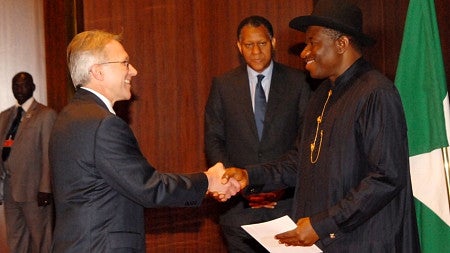
McCulley went on to earn senior positions abroad, including as deputy chief of mission at U.S. embassies in Togo, Senegal, Tunisia and Denmark. He was named U.S. Ambassador to Mali by President George W. Bush, and subsequently as a Barack Obama appointee as ambassador to Nigeria and to Côte d’Ivoire.
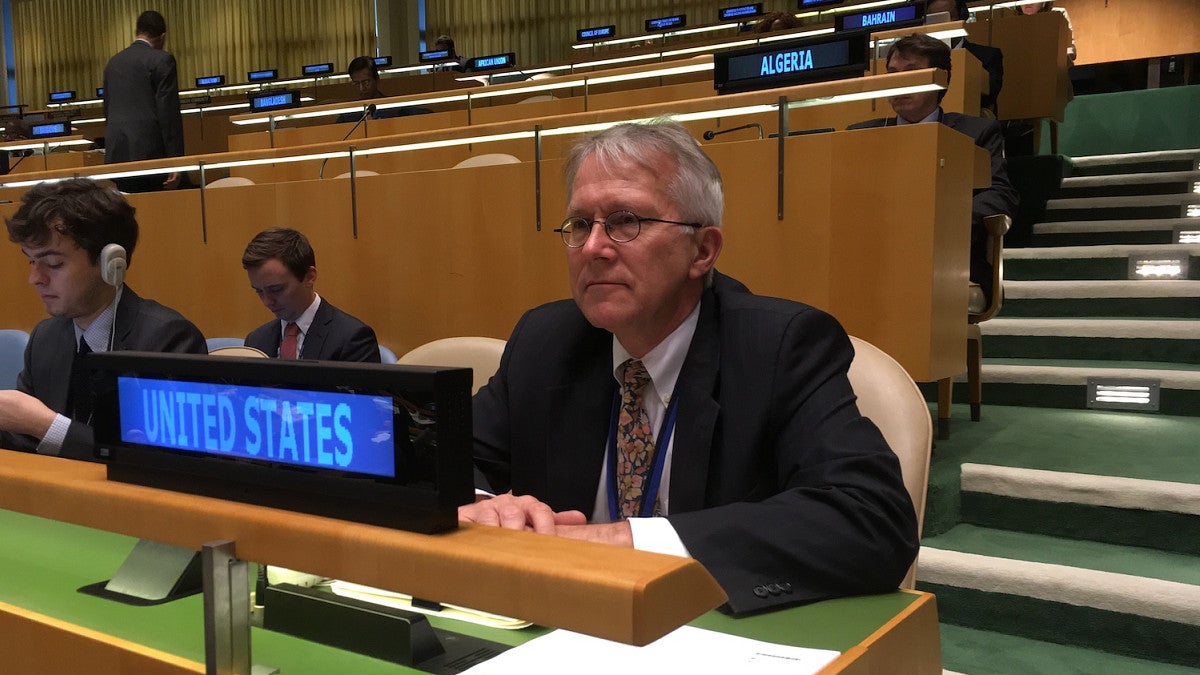
He retired from the State Department at the conclusion of his tour in Côte d’Ivoire in 2016 to be closer to family, returning to service part-time as the senior advisor for Africa at the U.S. Mission to the United Nations in New York during the UN General Assembly in 2016, 2017 and 2018.
Since then, McCulley has been working in the private sector for McLarty Associates where he helps businesses pursue their objectives across the African continent. He was offered the job by another former senior official who had left government to work for McLarty, and with whom he had formed a close connection during the latter’s mission to Mali leading a U.S. delegation to an international conference in Bamako. The position suited his skills and allowed him to work remotely from home in Bellingham, Washington.
“It’s a salutary tale of how important it is to never miss an opportunity to build your network of contacts at any point in your life,” he said.
He also serves as the chair of the U.S.-Nigeria Council for Food Security, Trade and Investment, a US-based non-profit dedicated to strengthening commercial and business ties between the two countries.
McCulley said his career demonstrates the benefits of leaning into the open-ended possibilities of another language.
“If you can anchor fluency in a foreign language,” he said, “you will be doing yourself an enormous service, whatever you decide to do, and it will offer multiple outlets and opportunities when you graduate.”